
Lithium battery regulations in the United States continue to evolve, creating new challenges for shippers, carriers, freight forwarders, and dangerous goods professionals. While much of the industry’s attention remains focused on familiar entries such as UN3480 and UN3481, regulators are already addressing new battery-powered technologies and exploring major changes that could reshape dangerous goods classification in the years ahead.
One example of this evolution is UN3536, “LITHIUM BATTERIES INSTALLED IN CARGO TRANSPORT UNIT.” Unlike some jurisdictions that continue to address emerging battery technologies through alternative regulatory mechanisms, the United States has already incorporated UN3536 into its Hazardous Materials Regulations through PHMSA guidance and regulatory provisions.
While UN3536 is now part of the regulatory landscape, it may be only the beginning of a much larger transformation.
What Is UN3536?
UN3536 was developed to address cargo transport units containing permanently installed lithium battery systems. These batteries are not being transported as cargo. Instead, they are installed within the transport unit itself and provide power to equipment associated with that unit.
A common real-world example is a refrigerated trailer equipped with a lithium-ion battery energy storage system that powers the refrigeration unit. The batteries remain installed within the trailer and provide power for refrigeration during transportation. Similar applications may include battery-powered auxiliary systems, telematics equipment, monitoring systems, liftgates, and other transport technologies.
As transportation equipment becomes increasingly electrified, these applications are becoming more common throughout supply chains.
Why UN3536 Matters
The introduction of UN3536 reflects a broader trend occurring throughout the transportation industry.
Historically, dangerous goods regulations focused on batteries being shipped as products. Today’s reality is different. Batteries are increasingly integrated into transportation equipment, cargo handling systems, trailers, containers, and supporting infrastructure.
This creates new classification questions:
- Is the battery cargo?
- Is it equipment?
- Is it part of a vehicle?
- Is it part of a cargo transport unit?

The answer can significantly impact shipping descriptions, documentation, marking, labeling, and transportation requirements.
For dangerous goods professionals, understanding these distinctions is becoming increasingly important as battery-powered transportation equipment becomes more prevalent.
The Next Major Lithium Battery Discussion
While UN3536 is now established within the U.S. regulatory framework, regulators are already discussing what may come next.
The primary driver behind the UN discussions is recognition that not all lithium batteries present the same transport hazard. Current UN numbers largely classify batteries by chemistry and configuration, whereas the proposed framework would classify batteries according to demonstrated hazard characteristics observed during standardized thermal runaway testing.
The UN Informal Working Group (IWG) on the Hazard-Based Classification of Lithium Batteries is evaluating both a simplified four-category model and a more detailed six-category model. Both approaches would classify batteries based on propagation behaviour, fire severity, heat release, toxic gas generation and re-ignition potential rather than chemistry alone.
The UN Sub-Committee of Experts on the Transport of Dangerous Goods is currently evaluating the IWG’s proposals, which could fundamentally change how lithium batteries are classified for transportation.
However, the scope of the discussions is significant.
Could 32 New Lithium Battery UN Numbers Be Coming?
Current proposals would move away from the existing approach of grouping many battery technologies under a small number of UN numbers.
Instead, batteries could be assigned classifications based on demonstrated hazard characteristics, including:
- Thermal runaway behaviour
- Fire intensity
- Heat generation
- Fire propagation potential
- Toxic gas production
- Re-ignition characteristics
Working papers have outlined a framework that could result in approximately 32 new UN numbers for lithium batteries, along with additional entries for sodium-ion batteries.
The objective is to classify batteries according to the hazards they present rather than relying primarily on battery chemistry or installation method.
If adopted, this would represent one of the most significant dangerous goods classification changes since lithium batteries were first introduced into the regulatory system.
What Happens to Class 9?
The discussions extend beyond UN numbers.
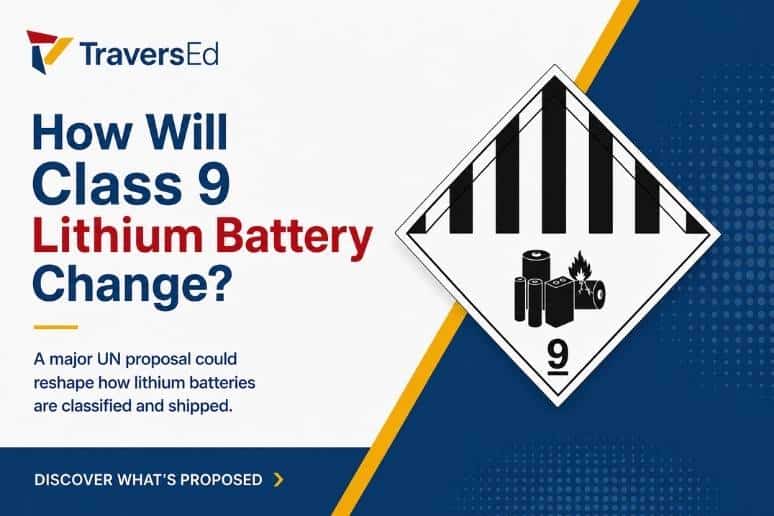
Today, lithium batteries are assigned to Class 9 and use the Class 9 lithium battery hazard label.
Current thinking favours retaining lithium batteries within Class 9 rather than creating a new hazard class. Instead, regulators are considering hazard-based divisions within Class 9, similar to what is seen with Class 1 explosives — working discussions have referenced divisions such as 9A through 9H — with any future category corresponding to the battery’s demonstrated hazard level during standardized testing. No final structure has been adopted.
The reasoning behind these discussions is straightforward. Not all lithium batteries behave the same way during thermal runaway events. Different technologies can produce significantly different fire, heat, gas generation, and propagation characteristics.
Regulators are exploring whether a single Class 9 designation adequately communicates these differences.
Could New Labels and Placards Be Introduced?
If hazard-based battery classifications are eventually adopted, new hazard communication requirements would almost certainly follow — and the impact could extend well beyond labels and placards. The framework could eventually touch packing instructions, quantity limits, segregation requirements and documentation across the UN Model Regulations, IMDG Code, ICAO Technical Instructions, IATA Dangerous Goods Regulations, and national regulations such as 49 CFR and Canada’s TDG Regulations.
Industry discussions have also included the possibility of new Class 9 labels, revised placards, and additional markings designed to communicate specific battery hazards more effectively.
At this stage, these remain concepts under development rather than finalized regulatory requirements, and no implementation timeline has been approved. Dangerous goods professionals should view these discussions as indicators of potential future direction rather than upcoming compliance obligations.
Why These Conversations Matter
It would be easy to dismiss these developments because many remain discussion papers rather than regulations.
However, UN3536 itself demonstrates why dangerous goods professionals should pay attention.
At one point, UN3536 was simply a response to emerging battery technologies and changing transportation practices. Today, it is an established classification used within the United States regulatory framework.
The same process may ultimately occur with hazard-based battery classifications, new UN numbers, and revised Class 9 categories. The proposal remains under active development by the UN Sub-Committee of Experts on the Transport of Dangerous Goods and its Informal Working Group on Lithium Batteries, with the number of categories still under discussion — so these working papers are best read as an indication of direction, not upcoming compliance requirements.
Organizations involved in dangerous goods transportation rarely have the ability to adapt overnight. New classifications, labels, packaging requirements, documentation standards, and training obligations often require years of preparation.
Conclusion: Importance of Ongoing Dangerous Goods Training
For dangerous goods professionals, compliance is no longer just about understanding today’s regulations. It is also about understanding the conversations that may shape tomorrow’s requirements.
The growing use of lithium batteries in transportation equipment, the adoption of classifications such as UN3536, and ongoing international discussions surrounding new UN numbers and Class 9 lithium battery categories/divisions all point toward a future where battery transportation regulations become increasingly sophisticated.
While the proposed hazard-based classification system remains under discussion and may ultimately be modified, delayed, or replaced entirely, it highlights an important reality: lithium battery transportation continues to be one of the fastest-evolving areas of dangerous goods regulation.
For freight forwarders, carriers, shippers, compliance professionals, and dangerous goods specialists, ongoing training remains one of the most effective ways to stay informed, remain compliant, and prepare for the regulatory changes that may lie ahead.
Investing in ongoing dangerous goods training today is one of the most effective ways to prepare for tomorrow’s lithium battery regulations.
